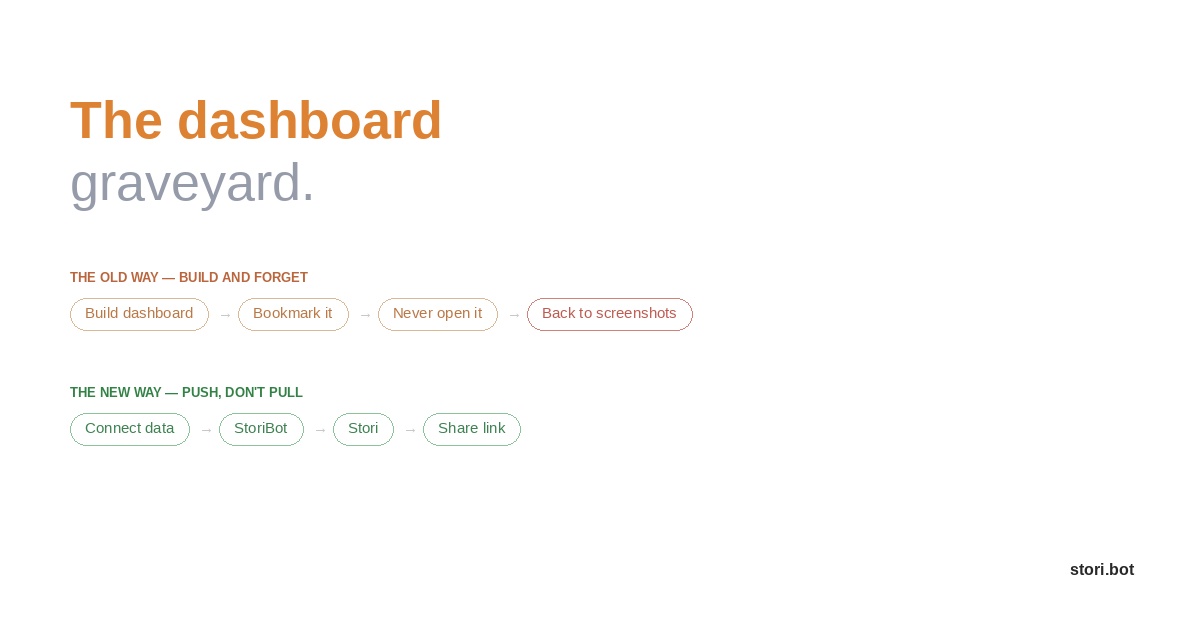
Every organisation has one. A Looker instance, a Tableau server, a folder full of Data Studio reports — all built with good intentions, bookmarked once, and never opened again. Welcome to the dashboard graveyard.
It's not that the dashboards were bad. The data was accurate. The charts were well-designed. Someone spent real time building them. And yet, three months later, the same team is back to pulling numbers manually from a spreadsheet and pasting them into a slide deck.
How dashboards vanish
Dashboards don't fail because they're wrong. They fail because they're built for the person who creates them, not the person who needs them.
An analyst builds a dashboard with filters, drill-downs, and toggles. It makes perfect sense to them. But the sales lead who's supposed to use it every day doesn't want to filter anything. They want to click a link and see this month's numbers compared to last month, with a summary ready to go.
The sales lead opens the dashboard once, finds it overwhelming, and goes back to their POS and the sales sheet summary in Google Docs. The dashboard sits untouched.
Drowning in data, starving for clarity
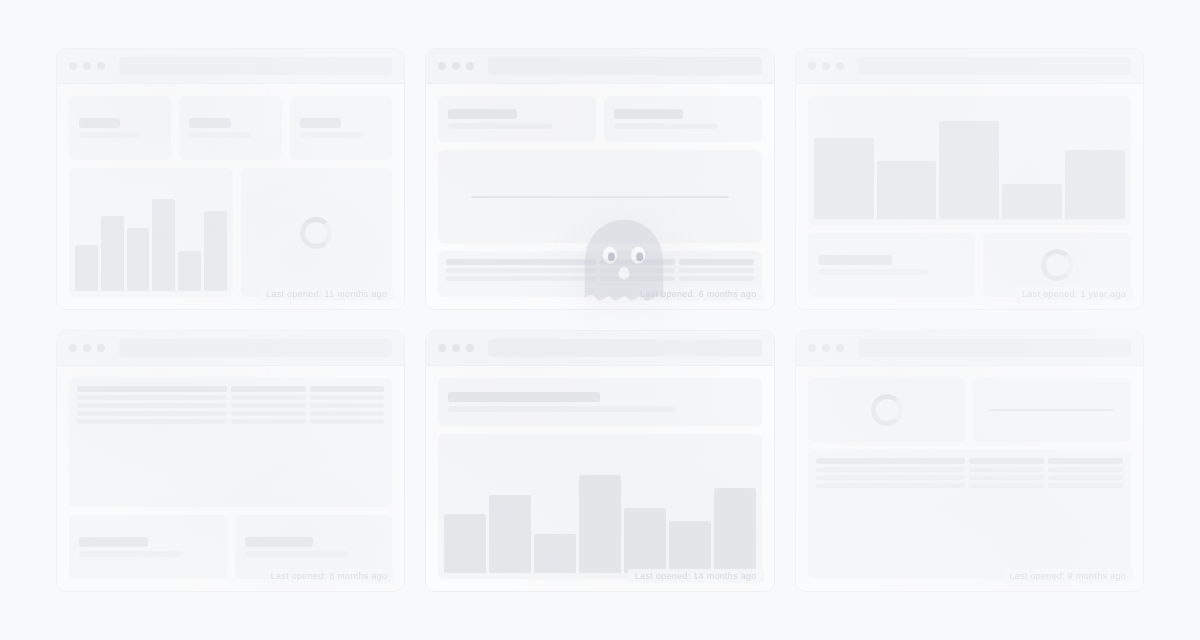
The dashboards aren't broken. The delivery model is. The irony is that most teams have more data and more dashboards than ever — and they still feel like they're walking blind. Teams spend countless hours collecting data, yet many aren't clear on what's working. They have the data. They just don't have a clean path from that data to a clear, contextualised insight that lands with the person who needs it.
The problem isn't the volume of data. It's the gap between where data lives (databases, spreadsheets, BI tools) and where decisions happen (meetings, inboxes, Slack threads). Dashboards were supposed to bridge that gap. Instead, they became another place where data sits, waiting for someone to go find it.
And no one does. Because people don't go to dashboards. They go to meetings. They check their inbox. They skim a Slack channel. The information needs to travel to them — not the other way around.
The real issue: dashboards are pull, not push
Dashboards operate on a pull model. They sit behind a login, waiting for someone to navigate there, remember which filters to apply, and interpret what they see. That works for analysts — people who live inside data tools all day. It doesn't work for the other 90% of the organisation.
The people who actually make decisions based on data — the marketing lead, the VP, the client, the board member — need a push model. They need the right information, with the right context, delivered to them in a format they can absorb in two minutes.
That means a curated set of insights, not a wall of charts. A narrative that says "here's what changed and here's what it means," not a grid of panels that says "explore at your leisure." An opinionated view of the data, shaped by someone who understands what this specific audience needs to know.
Think about the reports that actually get read at your company. They're probably not dashboards. They're probably a short email with three bullet points, a slide deck with five key charts, or a Loom walkthrough of the numbers. Someone took the raw data and did the editorial work — selecting, contextualising, narrating. The dashboard didn't do that work. A person did.
The fix isn't a better dashboard
The instinct, when dashboards go unused, is to build better dashboards. Cleaner layout. Fewer filters. Simpler charts. And sure, those things help at the margins. But they don't fix the underlying issue: a dashboard is fundamentally the wrong format for most of the people who need to see data.
What most teams actually need is a presentation layer. Something that takes the data they already have, applies the reporting logic they already know, and produces a focused, shareable output — a set of interactive data graphics someone can swipe through in 90 seconds. No login required. No filter fiddling. No "which tab do I look at?"
Configure it once. When the data changes, replay it. Send the link. The person who needs the information gets it in a format designed for them, not for the person who built it.
That's what StoriBot does. You connect a data source, describe what the audience needs to see, and the agent builds a Stori — a sequence of full-screen, interactive data graphics. Your reporting standards are encoded in the agent's instructions. Your audience gets a share link. When next month rolls around, you hit replay instead of rebuilding.
Empty the graveyard
If you've got dashboards that nobody opens, the problem probably isn't the dashboard. It's the gap between "data is available" and "the right person saw the right insight at the right time."
The fix isn't more charts. It's a better delivery model — one that pushes curated, contextualised data to the people who need it, in a format they'll actually look at.
See what connects → · See example Storis →
Related reading: